At what point does a leadership team realize the real issue is no longer whether AI can help, but who owns the route once the work starts moving?
This is where many enterprises are right now: they have interest, tools, and early wins, but no reliable way to coordinate them at scale.
This is why “agentic workforce” has become such a compelling phrase. It points to something larger than a chatbot or a single automation. It suggests a set of digital workers that can move work across systems, make bounded decisions, escalate exceptions, and keep a process moving. The opportunity is real. So is the danger of doing it casually.
Without orchestration, agents become freelancers with credentials. Without governance, speed becomes a source of operational doubt. Without a human review model, the organization discovers too late that no one can explain the path a decision took.
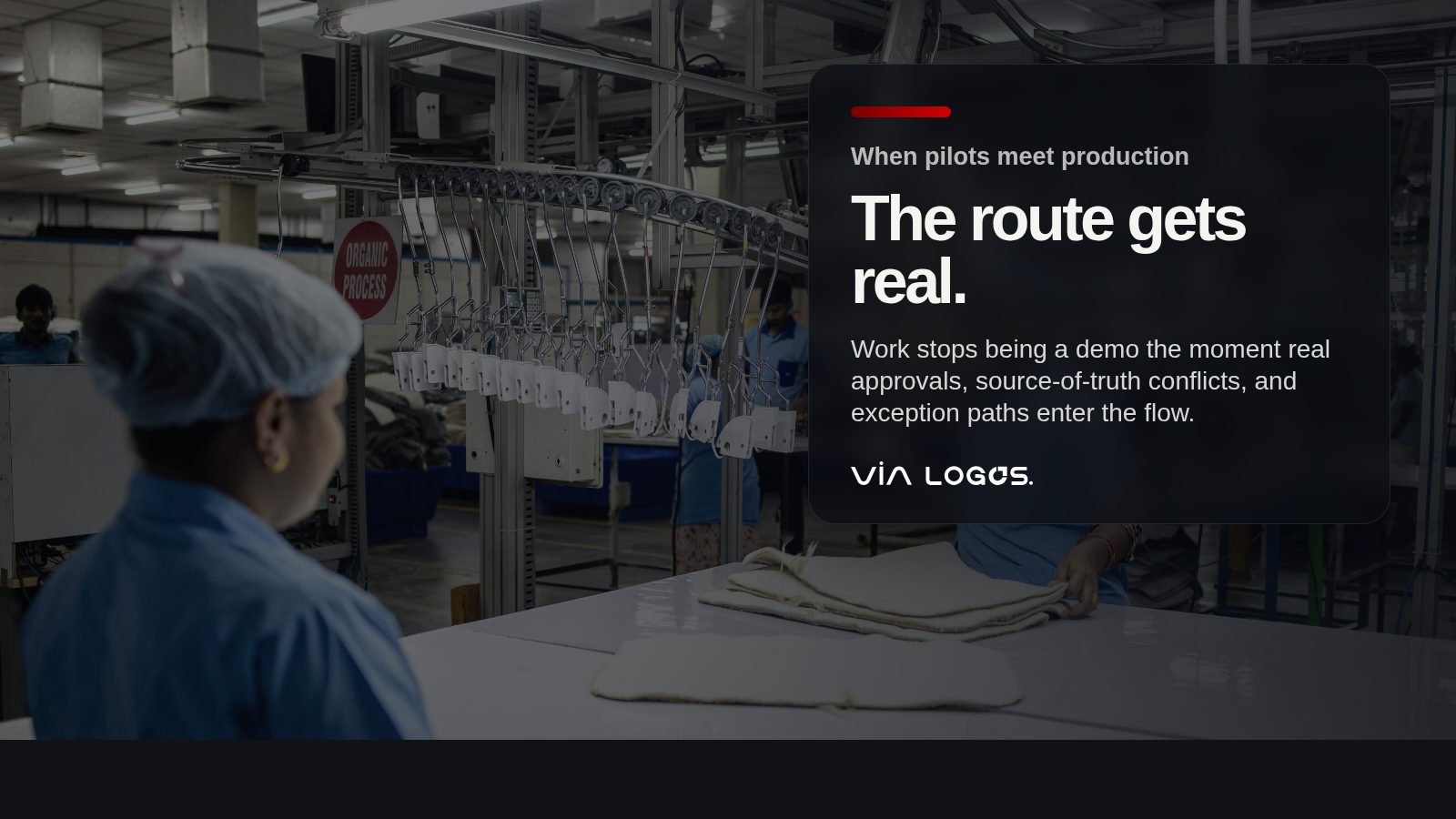
When pilots meet production, the route gets real: ownership, approvals, source-of-truth conflicts, and exception paths stop being abstract.
The hidden cost of pilot success
A pilot can boost morale and still leave the company unprepared for rollout.
Why? Because pilots are usually protected from the complexity that makes enterprise execution hard:
- cross-system handoffs
- compliance requirements
- conflicting sources of truth
- exceptions that need policy judgment
- release management when agent behavior changes
Once those realities enter the picture, the question changes from “can AI do this task?” to “can our organization run this workflow repeatedly, safely, and visibly?”
That is the right question.
The six commitments behind a controlled AI program
Once a pilot starts touching live teams, I look for six signs that the operating model can handle day-to-day work.
One workflow, one owner, one outcome
Pick a workflow that is already costing time or money, and put one owner on it. That owner needs a target concrete enough to judge, like cutting quote-preparation time for complex deals.
One orchestration layer
Someone, or something, has to coordinate the route. The orchestration layer decides sequence, retries, stop conditions, approvals, and escalation. It is the spine of the workflow.
Specialist roles, not general wandering
The best agentic systems use narrowly defined roles. One agent reconciles data. Another drafts a document. Another checks for policy gaps. Narrow roles are easier to trust, test, and improve.
Human judgment with explicit thresholds
Do not hide human review inside a vague sentence. Define when a person must step in. High-value transactions, missing documentation, confidence drops, compliance triggers, or policy conflicts are all examples of useful thresholds.
System boundaries that reflect reality
Real workflows touch CRM, ERP, ticketing, documents, and inboxes. Someone has to say which system owns each step and which ones are only feeding context into it. If that never gets settled, people start second-guessing the output.
Change control
Agent behavior is a production concern. When prompts, tools, rules, or model versions change, the workflow needs versioning, testing, and rollback discipline.

This is the practical shape of an agentic workforce: not autonomous chaos, but a governed route for work, decisions, and escalation.
A simple readiness table
| Question | If the answer is no | Why it matters |
|---|---|---|
| Do we know the workflow owner? | stop and assign one | orphaned workflows drift fast |
| Do we know the system of record at each step? | map the boundary first | this prevents duplicate truth |
| Do we know where human review must happen? | define thresholds | review needs operational reality |
| Do we know what exceptions look like? | design exception paths | happy-path automation is not enough |
| Do we know how changes will be released? | add versioning and rollback | trust depends on controlled change |
This is usually where the leadership conversation changes. Instead of asking which feature to pilot next, people start asking whether the workflow is ready for real traffic.
What first wins should look like
A good first implementation has three qualities:
- It touches a meaningful workflow, not a novelty task.
- It has visible handoffs where orchestration can remove friction.
- It can be measured without argument.
This is why the best first wins often live in onboarding, claims preparation, document review, partner operations, implementation handoffs, or internal service workflows. They are important enough to matter, structured enough to improve, and bounded enough to govern.
What you want from the first win is not just time savings. You want evidence that the organization can do four things at once:
- coordinate agents across systems
- preserve auditability
- keep human judgment where it belongs
- improve the workflow every week without creating fear
How to keep human judgment where it matters
One of the biggest mistakes in AI automation is treating human involvement like a sign that the system is weak. In serious organizations, human judgment is not a failure state. It is part of the architecture.
Humans should own:
- policy interpretation
- material exceptions
- final approval on sensitive outcomes
- changes to workflow rules
- periodic review of edge cases the system is learning from
That is how teams move faster without pretending the risk vanished. The system takes the repetitive load, and people still own the exceptions, approvals, and rule changes.
A current tracker for the steering group
If leadership wants a fair read on whether the program is healthy, keep a simple tracker like this:
| Workflow | Owner | Value metric | Control metric | Friction metric | Current status | Next action |
|---|---|---|---|---|---|---|
| Example: compliance packet assembly | Risk Ops | turnaround time | approval trace completeness | exception queue age | pilot live | reduce duplicate source checks |
If no one owns the friction, it just shows up somewhere else: an inbox, a Slack thread, or a queue that suddenly belongs to nobody.
What matters next
The organizations that benefit most from AI automation are usually not the ones that ran the most pilots. They are the ones that learned how to route work cleanly, respect system boundaries, and keep review visible.
That is the difference between a nice demo reel and a program leaders can run on Monday morning.
If you are exploring AI automation and want a grounded next step, book a consultation with Via Logos at https://via-logos.com or email team@vialogos.org. We will turn that first conversation into a written project pipeline, draft SoW(s), and an official quotation you can actually use internally.